
Teal Autumn Leaf Motif Lace Tablerunner: Free Crochet Pattern & Tutorial
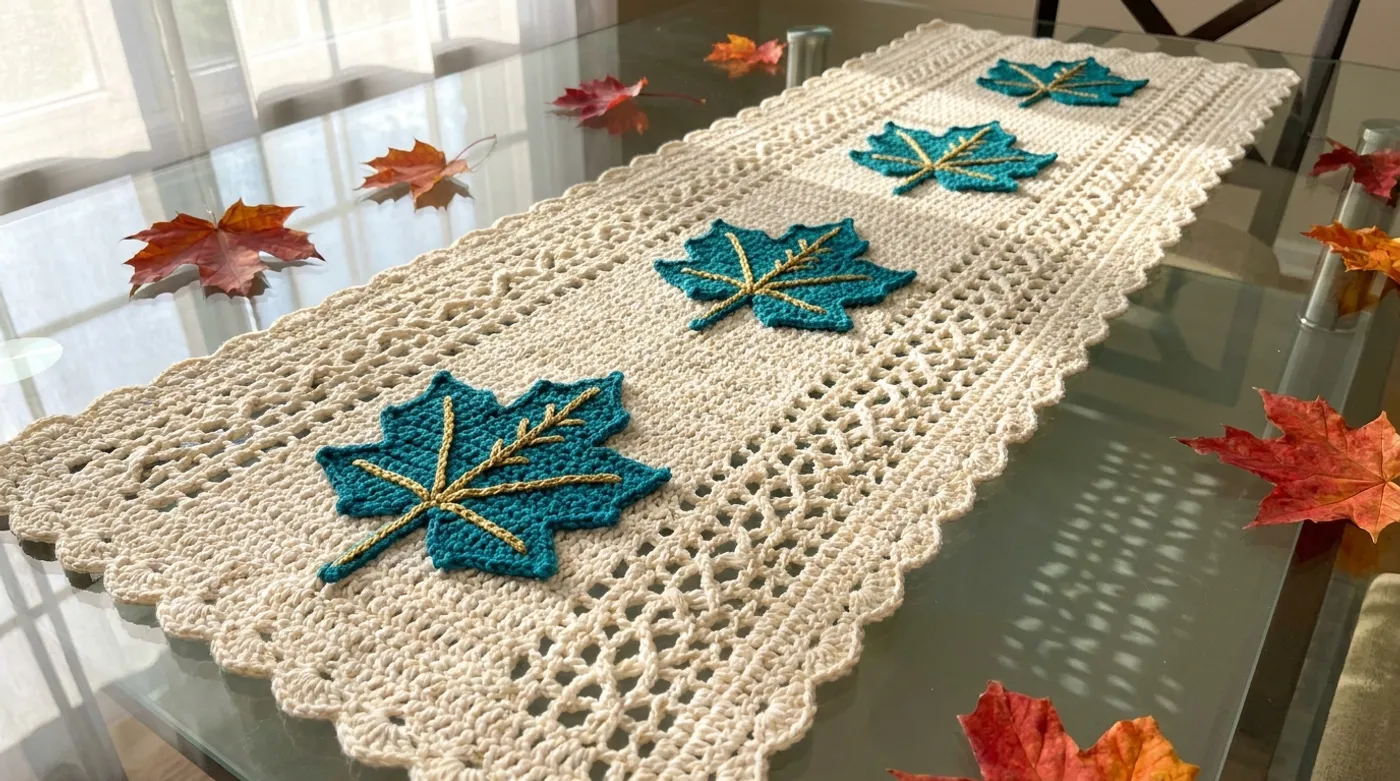
A long rectangular table runner of cream-ivory cotton worsted-weight yarn, 12–14 in wide and 70–80 in long, features an open-work lattice with a subtle helix twist and scalloped shell-stitch borders on all sides. Four solid teal 5-pointed leaf motifs are spaced evenly along th...

Pattern Specifications
Introduction & Design Inspiration
There is a particular hush that settles over a dining table when autumn arrives — the light slants lower, the air carries woodsmoke and ripe pear, and we find ourselves lingering over meals a little longer. This tablerunner was born from that exact atmosphere: the desire to capture a fleeting season in stitches that feel both deliberate and alive.
The design centers on an open-work lattice with a subtle helix twist, a structure that mimics the way fallen leaves spiral in a slow current. Worked in cream-ivory 100% cotton worsted-weight yarn, the fabric breathes; light passes through the diamond mesh, casting shifting shadows that change with the hour. Four solid teal five-pointed leaf motifs anchor the length, each rendered in tapestry crochet with gold yarn tracing the central vein and secondary venation. Front-post stitches lift those veins off the surface, giving each leaf a tactile, three-dimensional presence — as though you could pluck it from the runner.
Scalloped shell-stitch borders frame the long edges and both ends, their gentle undulation echoing the leaf margins themselves. No lining, no hardware — just yarn, hook, and the quiet satisfaction of watching a long rectangle grow row by row until it spans the full length of your table.
This pattern sits comfortably at the Intermediate level. You’ll need confidence with front-post stitches, tapestry color changes, and reading a repeating lace chart, but every technique is explained in the deep-dive section. The result is an heirloom piece that returns to the table each autumn, accumulating memories alongside the patina of use.
Pattern Overview & Finished Dimensions
-
Finished Width: 12–14 in (30–35 cm)
-
Finished Length: 70–80 in (180–200 cm) — adjustable in 8-row helix repeats
-
Structure: Rectangular lace tablerunner with scalloped shell borders on all four sides; four teal leaf motifs spaced evenly along center axis
-
Gauge: 16 sts × 10 rows = 4 in (10 cm) in open-work lattice pattern (measured after blocking)
-
Skill Level: Intermediate
-
Yarn Weight: Worsted (4) — 100% cotton recommended for stitch definition and washability
-
Hook: 5.0 mm (H-8) — adjust up/down 0.5 mm to meet gauge
-
Yardage: ~780 yds (713 m) total: 700 yds cream-ivory (main), 50 yds teal (leaves), 30 yds gold (veins)
-
Notions: Tapestry needle, blocking wires or T-pins, steam iron or garment steamer
Fit & Adjustment Notes:
The runner’s length is modular. Each full helix repeat adds 8 rows (~3.2 in / 8 cm). For a 70 in runner, work 22 repeats; for 80 in, work 25 repeats. Width is fixed by the foundation chain; if you prefer a narrower runner (10–11 in), reduce foundation chain by 12 stitches and adjust leaf placement accordingly.
Materials, Fiber & Hardware Checklist
| Item | Specification | Quantity / Notes |
|---|---|---|
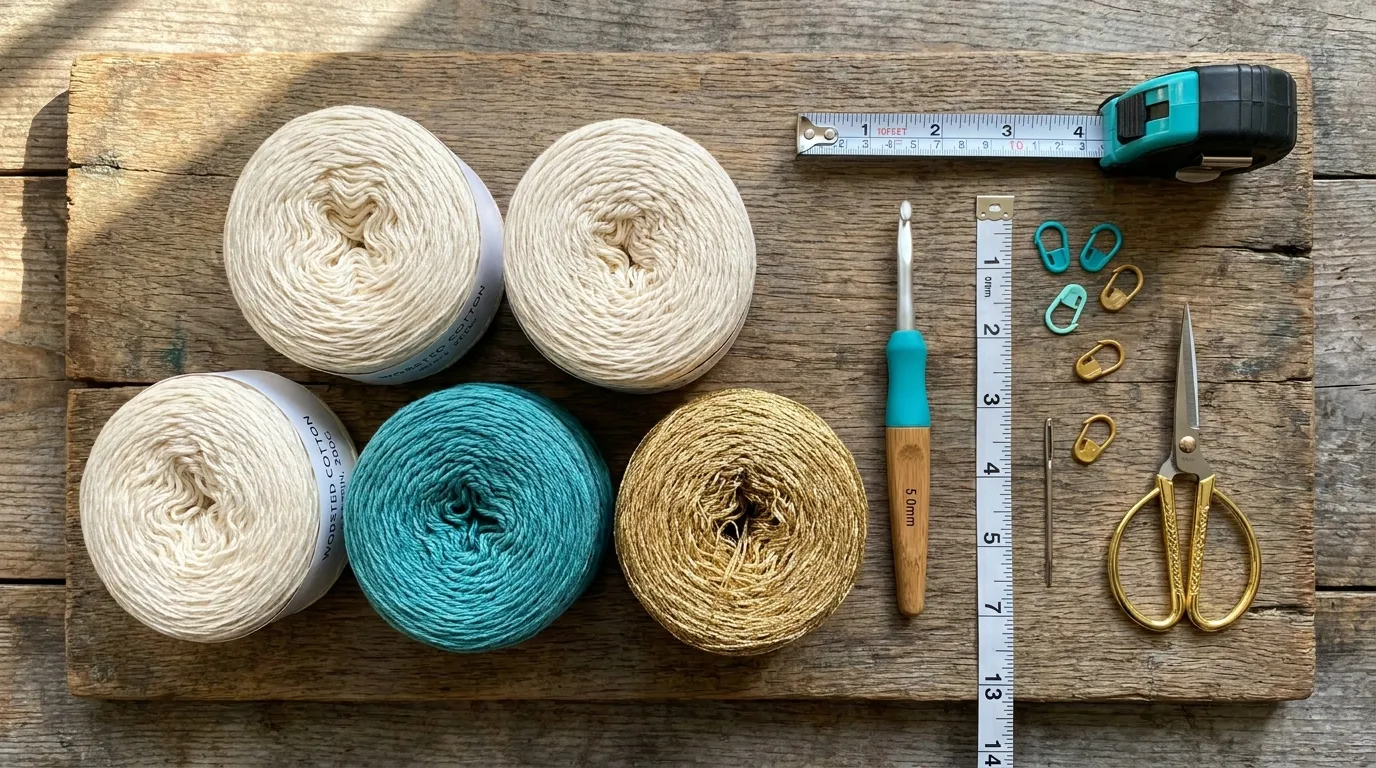
| Main Yarn (Cream-Ivory) | 100% cotton, worsted (4), ~218 yd / 100 g | 4 skeins (700 yds / 640 m) — Cascade Ultra Pima, Lion Brand 24/7 Cotton, or equivalent |
| Leaf Yarn (Teal) | 100% cotton, worsted (4), same brand/weight as main | 1 partial skein (50 yds / 46 m) — deep teal, e.g. “Peacock” or “Teal Blue” |
| Vein Yarn (Gold) | 100% cotton or cotton-metallic blend, worsted (4) | 1 partial skein (30 yds / 27 m) — metallic gold with subtle sheen |
| Crochet Hook | 5.0 mm (H-8) — inline or tapered per preference | 1 — adjust to achieve gauge |
| Tapestry Needle | Blunt tip, large eye | 1 — for weaving ends and seaming leaf motifs |
| Blocking Tools | Blocking wires (preferred) or T-pins, blocking mats | 1 set — essential for opening lace and shaping scallops |
| Measuring Tape | Flexible, 60 in / 150 cm | 1 |
| Stitch Markers | Locking or split-ring | 6–8 — for marking leaf motif centers and repeat boundaries |
Yarn Substitution Guidance:
Choose a mercerized or tightly plied cotton for crisp stitch definition. Avoid loosely spun or fuzzy yarns — they obscure the helix twist and muddy the gold veins. If substituting a cotton-linen blend, expect slightly more drape and a softer hand; block aggressively to set the lace.
Stitch Abbreviations (US Terms)
| Abbreviation | Meaning |
|---|---|
ch | chain |
sl st | slip stitch |
sc | single crochet |
hdc | half double crochet |
dc | double crochet |
tr | treble crochet |
fpdc | front post double crochet — insert hook from front to back around post of indicated stitch |
bpdc | back post double crochet — insert hook from back to front around post |
sk | skip |
sp | space |
ch-sp | chain space |
RS | right side |
WS | wrong side |
rep | repeat |
* * | repeat instructions between asterisks as directed |
[ ] | work instructions inside brackets into same stitch or space |
( ) | stitch group or repeat count |
Special Stitches:
-
Shell (5-dc shell):
[dc, ch 1, dc, ch 1, dc]in indicated stitch or space — creates scalloped border peak -
Helix Cross (HC):
sk next dc, fpdc around next dc 2 rows below, dc in skipped dc— creates the twisted lattice effect -
Leaf Cluster (LC): Worked over 5 stitches on RS rows — see Leaf Motif Chart in Phase 2
Architectural Mechanics / Technique Deep-Dive
The runner’s architecture rests on three interlocking systems: the helix lattice, the scalloped shell border, and the tapestry leaf motifs. Understanding how each behaves will make the pattern flow intuitively.
1. Helix Lattice — The Twisted Diamond Mesh
The body fabric is a simple dc/ch-1 mesh (dc, ch 1, sk 1, dc) on the foundation row. The twist emerges on every 8th row: instead of working dc into the next dc, you skip that dc, work a fpdc around the dc two rows below (the corresponding stitch in the previous mesh row), then return to work a dc into the skipped stitch. This front-post stitch pulls the lower row forward, rotating the diamond mesh 45° and creating a subtle helical ridge that travels diagonally across the width. The effect compounds over repeats — after 8 rows, the twist completes one full cycle and the mesh realigns, ready for the next helix cross row.
Why it works: Front-post stitches draw yarn from the row below, shortening the vertical distance and forcing the fabric to torque. Because the crosses are staggered every 8 rows, the torque distributes evenly, preventing biasing. Cotton’s low elasticity locks the twist in place after blocking.
2. Scalloped Shell Border — Self-Edging as You Go
Rather than adding a separate border, the shell edging is worked into the last stitch of each row on both long edges, and across the foundation and final rows on the short ends. The 5-dc shell ([dc, ch 1, dc, ch 1, dc]) fans into the edge stitch, creating a natural scallop. On the long edges, shells are placed every 4 rows (every other RS row), aligning with the helix rhythm. On the short ends, shells fill every ch-1 space of the foundation/final row.
3. Tapestry Leaf Motifs — Colorwork in the Mesh
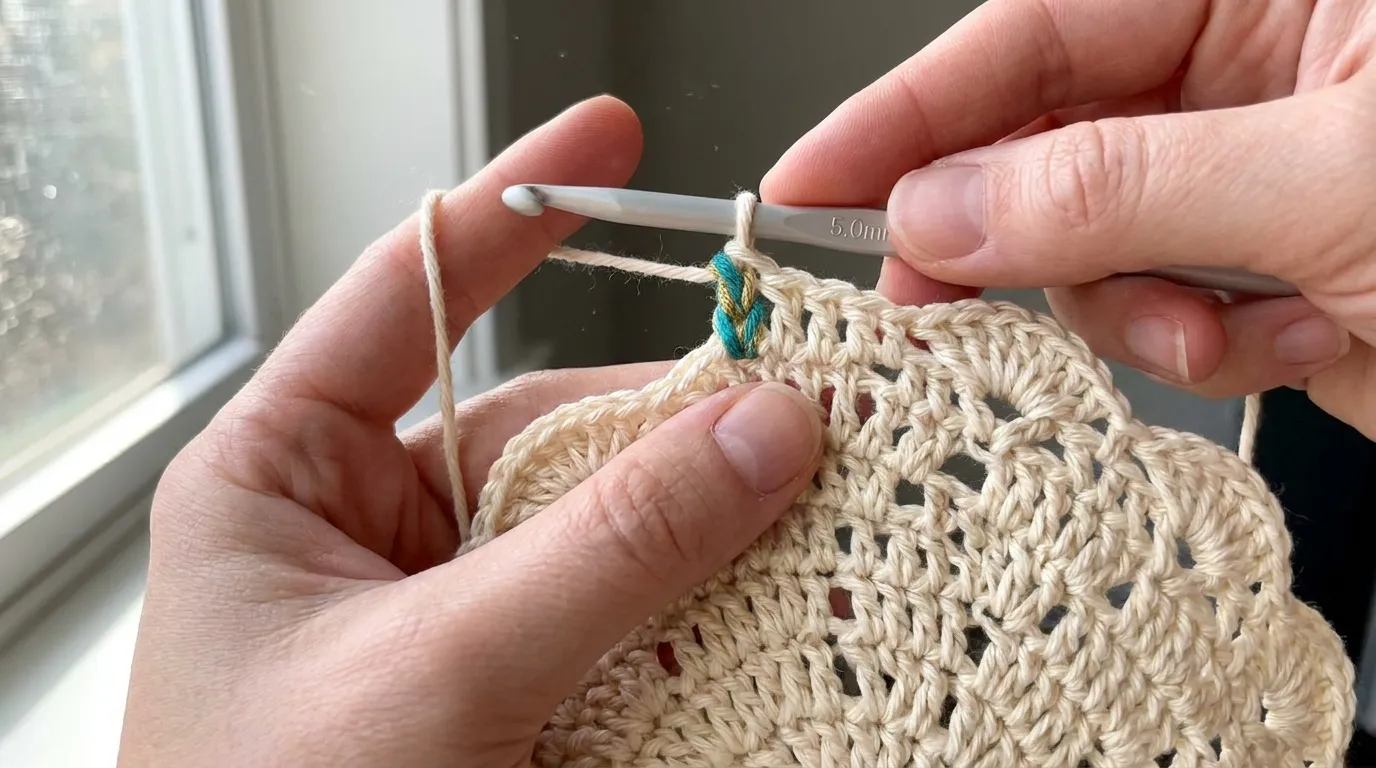
Each leaf sits in a 13-row × 11-stitch window centered on the runner’s midline. The leaf is worked in teal using tapestry crochet: carry the gold vein yarn along the back of the work, dropping and picking up per the chart. The central vein and secondary veins are not surface-embroidered — they are crocheted as fpdc stitches on the RS rows, raising them physically above the teal fabric. On WS rows, the gold yarn is carried hidden behind the teal stitches.
Key Tapestry Rules:
- Always carry the non-working yarn loosely across the back — tension it just enough to avoid floats snagging.
- Change colors before completing the last yarn-over of the stitch before the color change.
- On WS rows, work all stitches in teal; gold is only worked on RS rows as
fpdcveins. - Block each leaf motif individually with a steam iron before blocking the full runner — this sets the raised veins.
Step-by-Step Stitch Instructions
Phase 1: Foundation & Border Setup
Foundation Row (RS): With cream-ivory, ch 67 (or 55 for narrow version).
Row 1 (RS): Dc in 4th ch from hook (counts as dc + ch-1 sp), ch 1, sk 1 ch, dc in next ch; rep from * across to last ch, dc in last ch. 33 dc + 32 ch-1 sps. Turn.
Row 2 (WS): Ch 3 (counts as dc), dc in first dc, ch 1, sk ch-1 sp, dc in next dc; rep across, ending with dc in top of turning ch. Turn.
Rows 3–7: Rep Row 2. You now have 7 rows of plain dc/ch-1 mesh. Place a locking marker at each end of Row 7 — these mark the first helix cross row.
Border Initiation (Long Edges):
On Row 4 (RS) and every subsequent RS row divisible by 4 (Rows 4, 8, 12, 16…), work a shell in the last dc of the row before turning: [dc, ch 1, dc, ch 1, dc] in last dc, then turn. This creates the first scallop on the right edge.
On Row 6 (WS) and every subsequent WS row divisible by 4 (Rows 6, 10, 14…), work a shell in the first dc of the row after the turning ch: ch 3, [dc, ch 1, dc, ch 1, dc] in first dc, then continue Row 2 pattern across. This creates scallops on the left edge.
Border Rhythm: Right-edge shells on RS rows 4, 8, 12…; Left-edge shells on WS rows 6, 10, 14… Continue this rhythm for the full length.
Phase 2: Helix Lattice & Leaf Motifs
Helix Cross Row (Row 8 — first cross row):
Ch 3 (counts as dc), ch 1, sk next dc, fpdc around dc 2 rows below (Row 6), dc in skipped dc; rep from * across to last dc, dc in last dc. Turn.
Row 9–15: Rep Row 2 (plain mesh). Maintain border shell rhythm.
Row 16: Rep Helix Cross Row (Row 8).
Helix Repeat Formula:
Work Helix Cross Row on Row 8 and every subsequent 8th row (Rows 8, 16, 24, 32, 40, 48, 56, 64, 72, 80, 88, 96, 104, 112, 120, 128, 136, 144, 152, 160, 168, 176…). All other rows are plain mesh (Row 2) with border shells per the rhythm above.
Leaf Motif Placement:
Four leaves are centered at rows 40, 72, 104, 136 (each 32 rows / ~12.8 in apart). Each leaf spans 13 rows (6 RS + 7 WS) and 11 stitches (centered on stitch 17 of 33).
Leaf Motif Chart (RS Rows Only — WS rows are plain teal mesh):
Stitch numbers refer to the 11-stitch window (stitches 13–23 of the 33-stitch row). Gold = fpdc (vein), Teal = dc (leaf body). Carry gold on WS.
| Row (RS) | Stitch Pattern (11 sts) | Notes |
|---|---|---|
| Leaf Row 1 (Row 40) | T T T T G T T T T T T | G = central vein base (fpdc around Row 38 dc) |
| Leaf Row 2 (Row 42) | T T T G T G T T T T T | Two secondary veins begin |
| Leaf Row 3 (Row 44) | T T G T T T G T T T T | Veins branch outward |
| Leaf Row 4 (Row 46) | T G T T T T T G T T T | Widest point — 5-point tips form |
| Leaf Row 5 (Row 48) | G T T T T T T T T G T | Tips taper |
| Leaf Row 6 (Row 50) | T T T T T T T T T T T | Final teal row — no gold; bind off leaf color |
Executing a Leaf Row (RS):
Work plain mesh to stitch 13. Drop cream, pick up teal (carry gold behind). Work 11 stitches per chart: dc for T, fpdc around corresponding stitch 2 rows below for G. Drop teal, pick up cream, finish row. On following WS row, work plain mesh in cream across entire row — teal and gold are carried hidden behind the work. Resume leaf chart on next RS row.
Carrying Yarn Across Leaf Rows:
On WS rows between leaf RS rows, carry both teal and gold loosely along the back. Do not cut teal until Leaf Row 6 is complete. Cut gold after final vein on Leaf Row 5; rejoin gold at next leaf.
Phase 3: Completion & End Borders
Continue helix repeats and border rhythm until desired length (Row 176 for ~70 in, Row 200 for ~80 in). End on a WS row.
Final Row (RS — End Border):
Ch 3, dc in first dc, ch 1, sk ch-1 sp, shell in next dc [dc, ch 1, dc, ch 1, dc]; rep from * across to last dc, dc in last dc. Fasten off.
Foundation Row Border (RS — work into foundation chain edge):
With RS facing, join cream with sl st in first foundation ch. Ch 3, shell in next ch-1 sp [dc, ch 1, dc, ch 1, dc], sk next ch; rep across, ending with sl st in last ch. Fasten off.
Weave All Ends: Use tapestry needle to weave ends into the dense shell borders and mesh — avoid pulling through open lace where ends may show.
Assembly, Mounting & Structural Integration
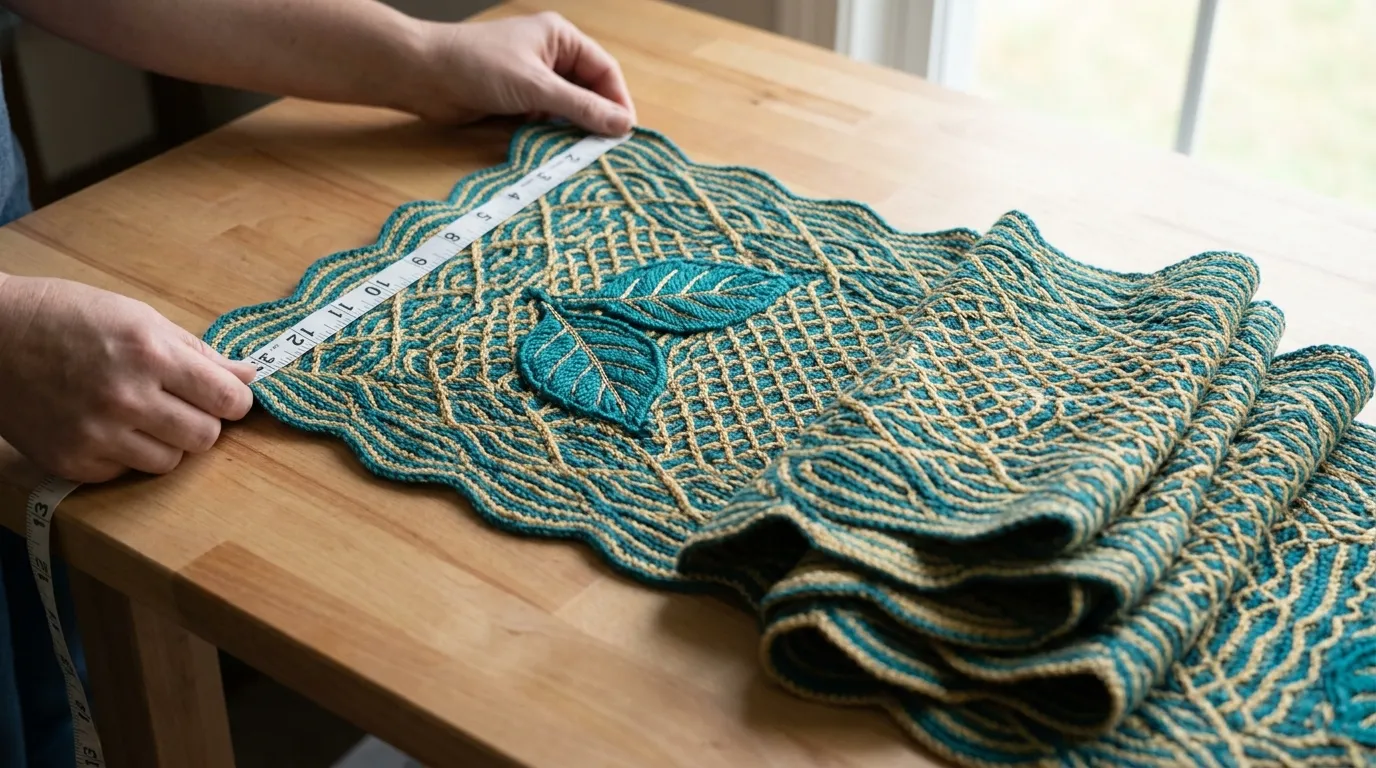
This piece requires no seaming, lining, or mounting — it is a single continuous fabric. The only “assembly” is blocking, which is non-negotiable for lace.
Blocking Protocol:
- Soak runner in cool water with wool wash (e.g., Soak or Eucalan) for 15 minutes. Do not agitate.
- Press water out in a towel — do not wring.
- Lay flat on blocking mats. Thread blocking wires through the outermost dc of each shell along both long edges. Pin wires to achieve 13 in width (or your target).
- Pin short ends to target length (70–80 in), gently stretching the helix mesh to open diamonds.
- Steam heavily with a garment steamer or steam iron held 1 in above fabric — do not press. The heat sets the cotton’s twist memory.
- Leave pinned until bone dry (24–48 hours). Remove wires.
Post-Blocking Check:
- Measure width at 3 points — should be consistent ±¼ in.
- Leaf motifs should lie flat with veins visibly raised. If any vein flattened, re-steam that spot from the WS.
- Shell scallops should be crisp and even.
Hardware, Accents & Embellishment Assembly
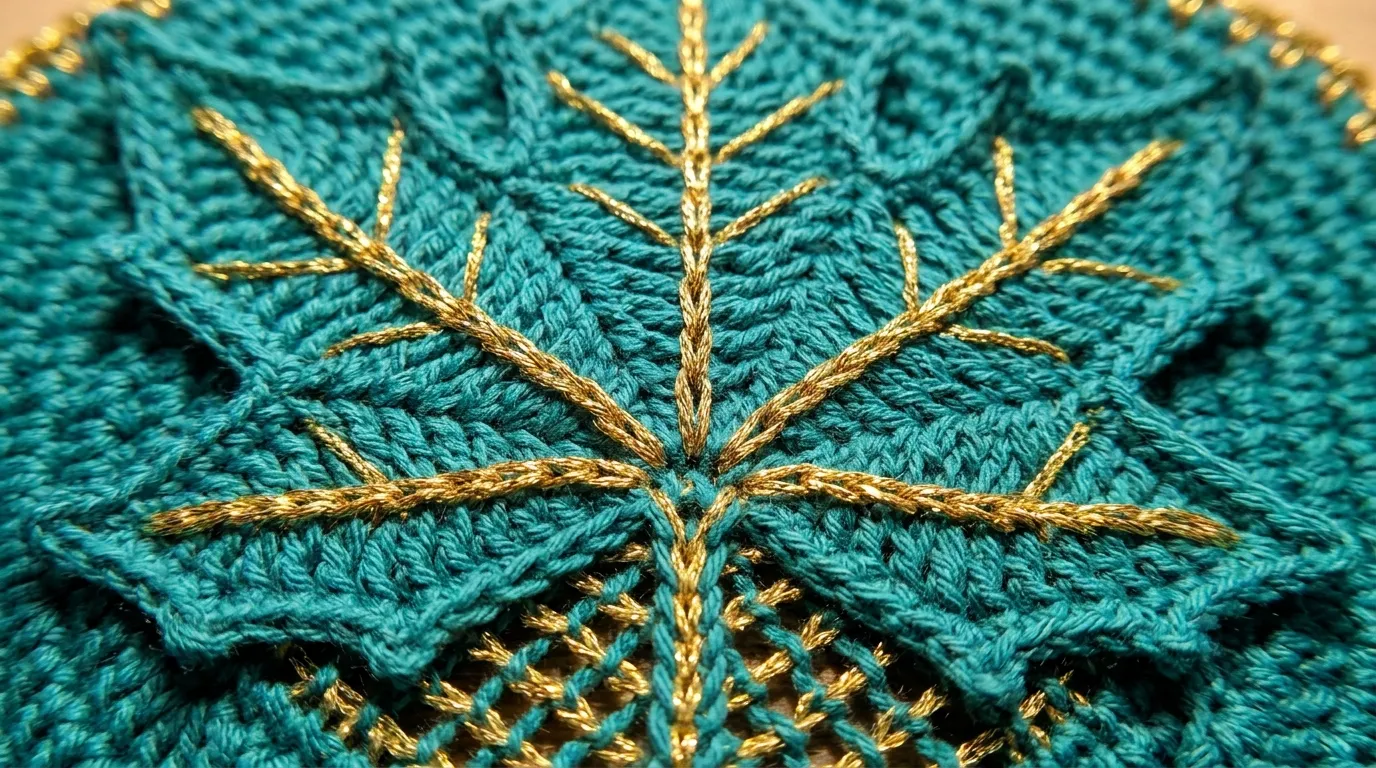
No hardware is used in this design. The gold vein yarn is the accent — its metallic sheen catches light as the runner shifts. If you wish to add a subtle flourish, consider:
-
Tassels at corners: 4 in tassels in cream with a single gold thread — attach to the center dc of each corner shell after blocking.
-
Beaded vein tips: Thread a size 6/0 gold seed bead onto the gold yarn before the final
fpdcof each vein tip (Leaf Row 4). This adds a tiny catch of light at each leaf point.
Both are optional. The design’s elegance lies in its restraint.
Blocking, Care & Maintenance
Washing: Hand wash in cool water with pH-neutral detergent. Press water out in towels. Do not machine wash or dry.
Blocking: Re-block after every 3–4 washes to refresh the helix twist and shell scallops.
Storage: Roll (don’t fold) around an acid-free cardboard tube. Store in a cotton pillowcase or muslin bag — avoid plastic, which traps humidity.
Ironing: If needed, steam only from WS. Never press directly — the raised veins and shell texture will flatten permanently.
Stain Treatment: Spot-treat immediately with cool water and a drop of detergent. Rinse by dabbing with clean damp cloth. Re-block the affected section.
Frequently Asked Questions (FAQ)
Q: Can I use a different yarn weight — say, DK or fingering?
A: Yes, but dimensions and yardage will shift. For DK (3), use a 4.0 mm hook and expect ~15% less yardage; the runner will be finer and shorter at the same row count. For fingering (1), use 3.0 mm hook and double the row count for equivalent length. Always swatch and measure gauge — the helix twist relies on the fpdc pulling from two rows below, which behaves differently at each gauge.
Q: My helix crosses are pulling the fabric diagonally — the runner is biasing.
A: This usually means your fpdc tension is too tight. The front-post stitch should hug the lower post without cinching. Try: (1) use a hook 0.5 mm larger for cross rows only, (2) consciously loosen your yarn-over on the fpdc, (3) block aggressively — cotton relaxes dramatically under steam. If biasing persists, work a plain mesh row between cross rows (i.e., cross every 10 rows instead of 8).
Q: The gold vein yarn keeps showing on the wrong side.
A: On WS rows, carry the gold behind the teal stitches, not across the front. When switching from teal to gold on an RS row, bring the gold up under the teal strand so it locks into the back of the fabric. If a float peeks through, use a tapestry needle to tuck it behind the adjacent teal stitch after blocking.
Q: How do I adjust the length for a specific table?
A: Measure your table top, subtract 12–18 in for overhang (6–9 in per end). Divide target length by 3.2 in (the length added per 8-row helix repeat). Round to the nearest multiple of 8 rows. Example: 72 in table → 60 in runner → 60 ÷ 3.2 ≈ 18.75 → work 16 or 24 cross rows (128 or 192 total rows). Place leaves at ¼, ½, ¾, and full length markers.
Community Call-to-Action
You’ve crocheted a piece that holds autumn in its stitches — helix twists catching morning light, gold veins glowing like gilded foliage, scallops framing meals not yet shared. That quiet magic deserves to be seen.
Share your finished tablerunner with us:
📸 Post on Instagram and tag @NailItHome with #NailItHomeAutumn
📌 Pin your project photo to your “Seasonal Crochet” board on Pinterest
💬 Leave a comment below — tell us your table’s dimensions, your yarn choices, or the meal you’ll serve atop it first
Every maker’s interpretation — tighter twist, deeper teal, longer length — becomes part of the pattern’s living archive. We can’t wait to see yours.
Pattern © 2026 Aurelia Thorne for Nail It Home. Free for personal use. Do not reproduce or sell the pattern text. Finished items may be sold in small quantities with credit: “Pattern by Aurelia Thorne @ NailItHome.net”.