
Botanical Leaf & Blossom Crochet Table Runner: Free Pattern & Tutorial
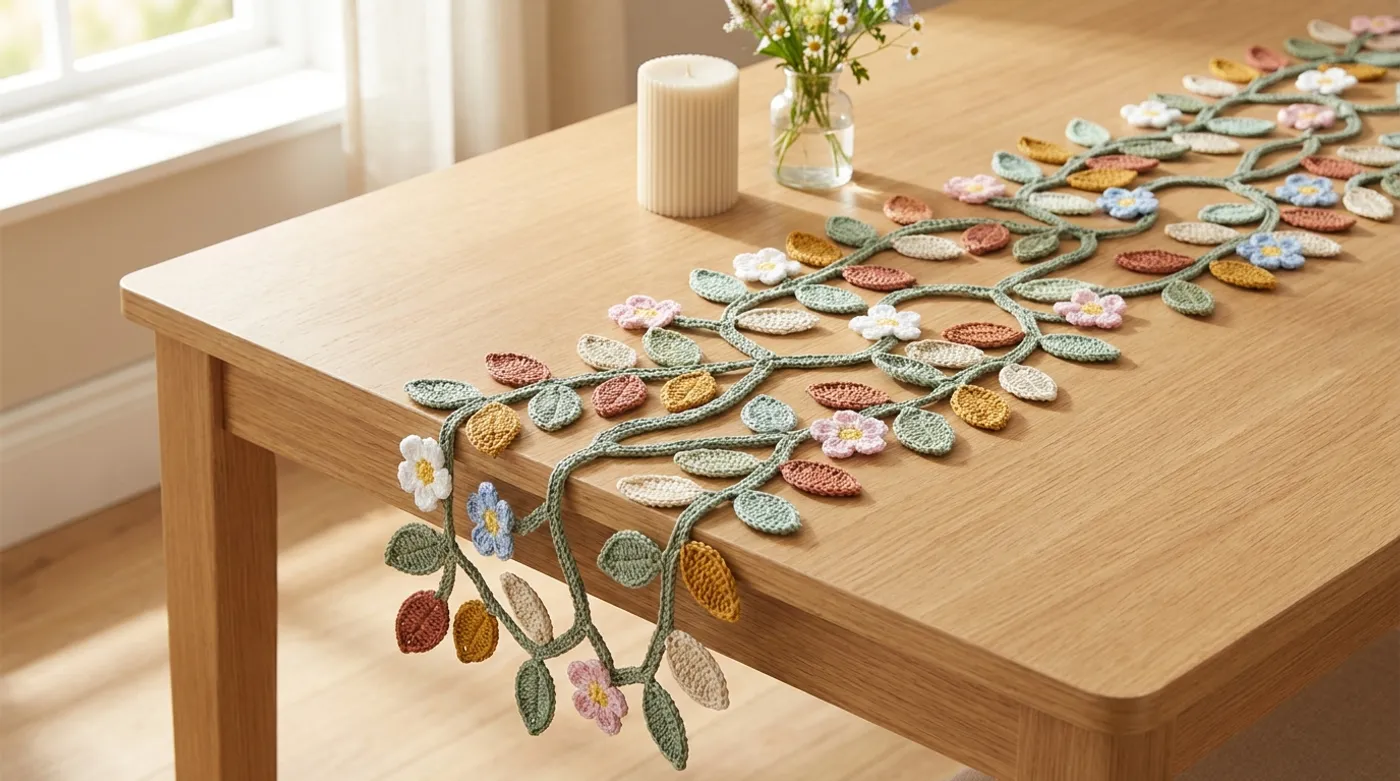
Bring the graceful beauty of wildflower vines into your home with this openwork botanical table runner, featuring sinuous leaf tendrils and delicate pastel blossoms.

Pattern Specifications
There is a timeless grace to botanical forms winding organically across a dining table. While dense woven runners create a solid block of color, an openwork botanical vine interacts directly with the surface underneath, letting the natural grain of oak, maple, or weathered pine glow through its negative spaces. The Botanical Leaf & Blossom Crochet Table Runner was born from a desire to capture the delicate, wandering movement of climbing morning vines dotted with meadow blooms.
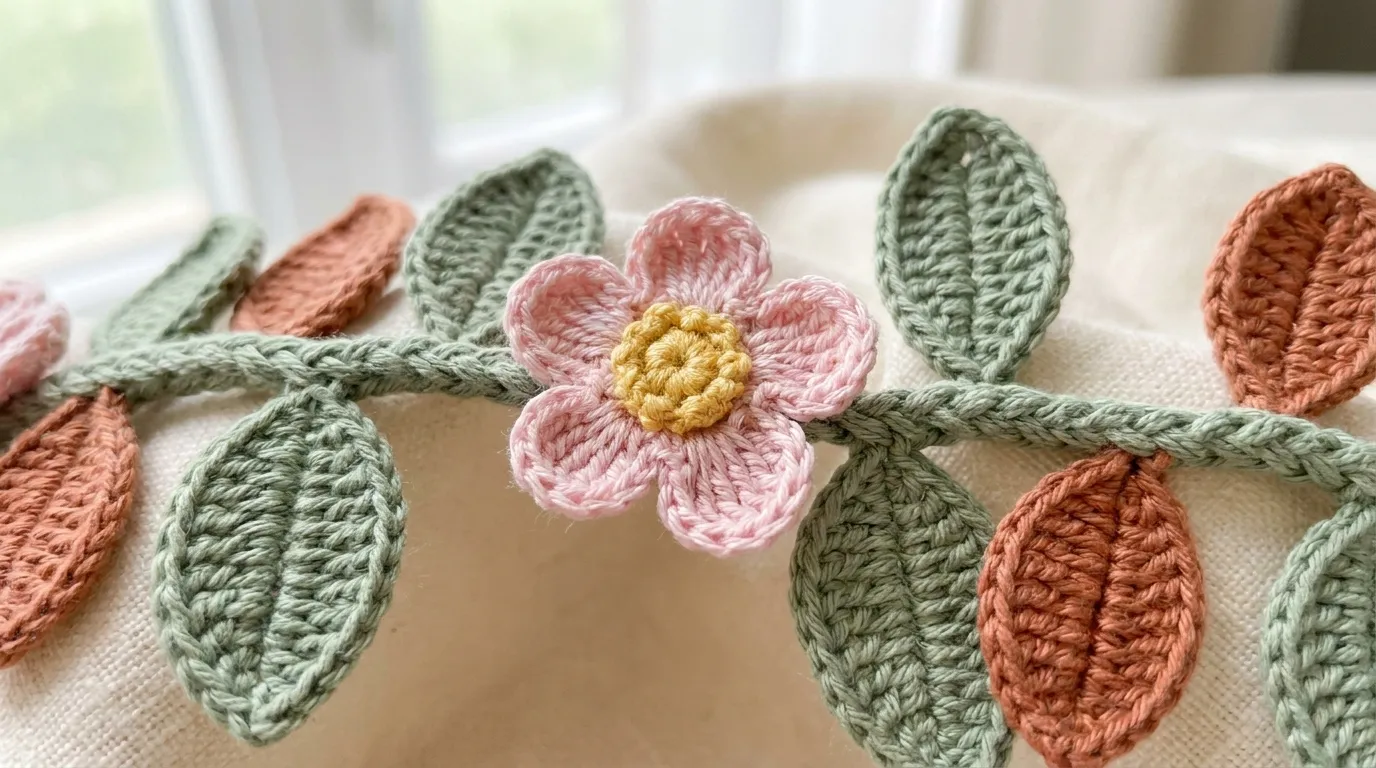
Crocheted using smooth DK-weight combed cotton, this runner combines continuous cord stemwork with individually sculpted oval leaflets in a serene earthy palette: soft sage green, pale mint, dusty terracotta peach, warm mustard ochre, and gentle ecru. Sprinkled along the vines are sweet five-petal blossoms in soft pastels—primrose white, delicate blush pink, and pale sky blue—each anchored with a textured sunburst yellow stamen.
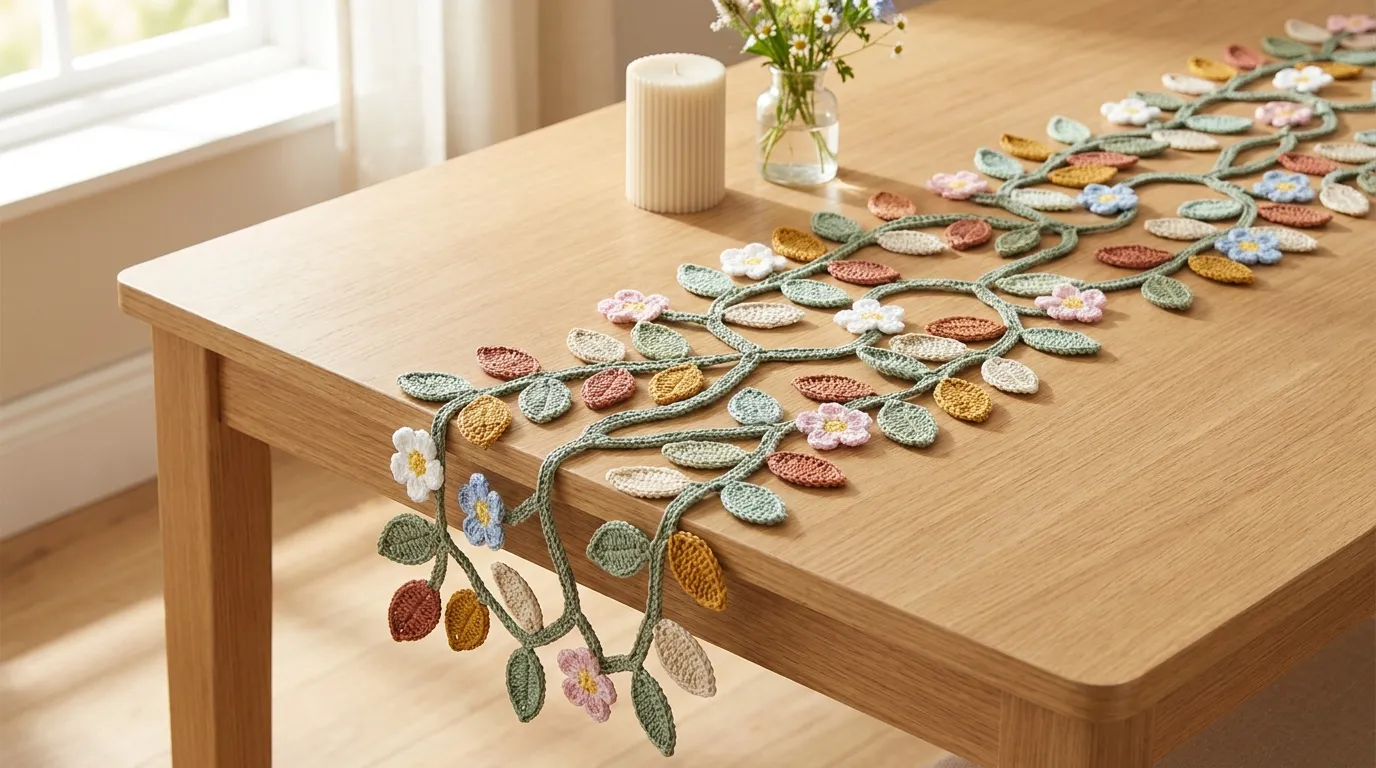
The open trellis architecture of this design makes it remarkably versatile. Because it is assembled from modular branching vine sections, you can scale it from a petite coffee-table centerpiece to a dramatic 70-inch holiday runner. Below, we walk through the exact botanical mechanics, stitch foundations, flower construction, and layout pinning.
Pattern Overview & Dimensions
- Design Style: Openwork botanical vine runner with sculpted leaflets and dimensional blossom accents.
- Finished Width: Approx. 11 to 13 inches (28 to 33 cm) across the widest branching leaf clusters.
- Finished Length: Approx. 48 inches (122 cm) as written (easily extended in 8-inch vine repeats).
- Motif Dimensions:
- Standard Oval Leaflet: 2.75 in long x 1.5 in wide (7 cm x 3.8 cm).
- Petite Tapering Leaflet: 2.0 in long x 1.0 in wide (5 cm x 2.5 cm).
- Five-Petal Blossom: 1.75 in diameter (4.5 cm).
- Total Element Count for 48-inch Runner:
- 1 Central Main Spine Vine (approx. 48 inches).
- 8 Lateral Branch Vines (approx. 10 to 14 inches each).
- 34 Standard Leaflets (14 Sage Green, 6 Dusty Terracotta, 6 Mustard Ochre, 4 Mint, 4 Cream).
- 12 Petite Accent Leaflets (Olive & Sage).
- 14 Five-Petal Blossoms (6 White, 5 Baby Pink, 3 Sky Blue, all with Yellow stamens).
Materials & Notions Checklist
To maintain crisp leaf edges and supple vine draping without stiff synthetic shine, choose a 100% mercerized or combed cotton DK (Category 3) yarn. Cotton holds crisp wet-blocking pins and will not curl under dinnerware.
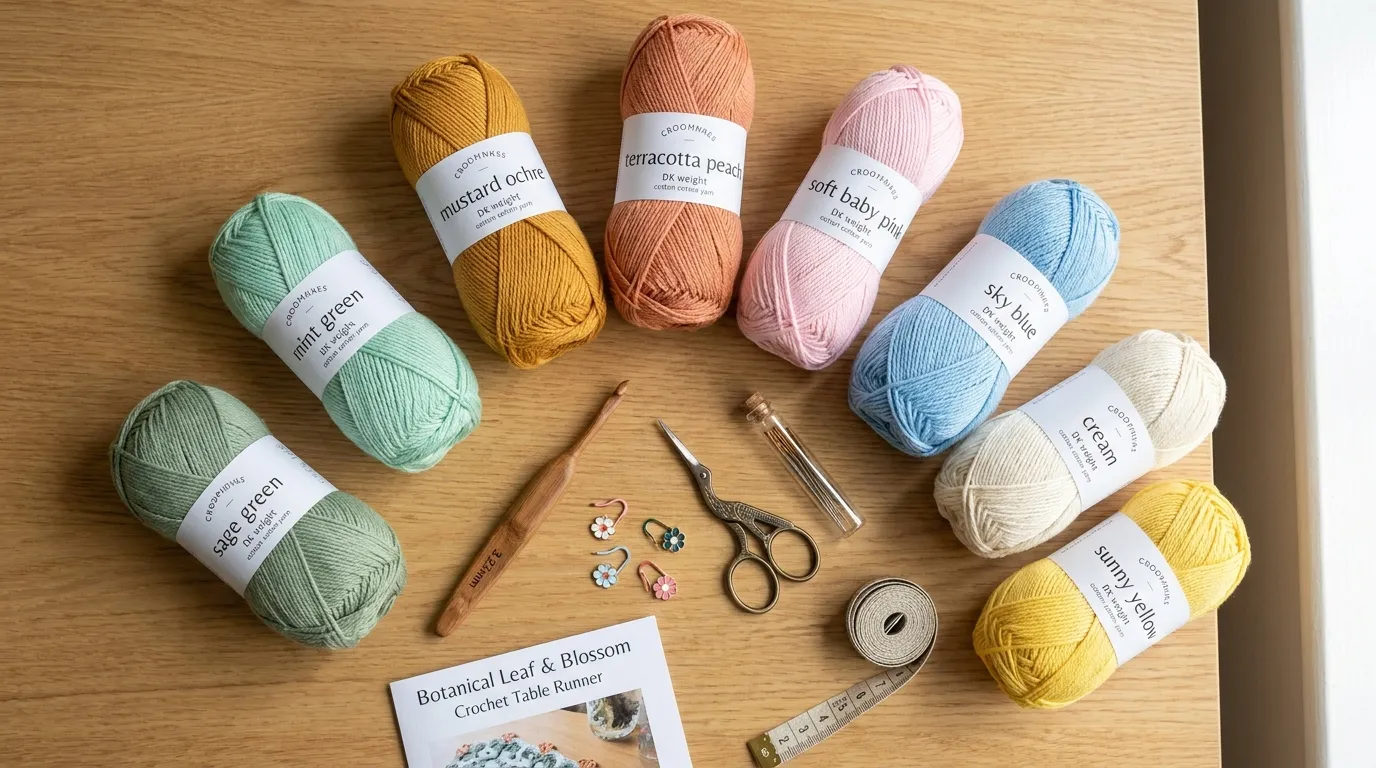
Yarn Requirements (DK Weight / Light Category 3):
- Stem & Dominant Leaves (Sage Green): Approx. 320 yards (292 m).
- Secondary Leaves (Soft Mint Green): Approx. 110 yards (100 m).
- Warm Foliage (Dusty Terracotta Peach): Approx. 100 yards (91 m).
- Golden Foliage (Mustard Ochre): Approx. 90 yards (82 m).
- Blossom Petals (Cream, Soft Pink, Sky Blue): Approx. 120 yards (110 m) combined.
- Blossom Centers (Sunny Yellow): Approx. 40 yards (37 m).
Tools & Haberdashery:
- Crochet Hook: 3.25 mm (US D-3) ergonomic wooden or aluminum hook.
- Tapestry Needle: Size 16 bent-tip blunt needle for invisible joinery and weaving ends.
- Scissors: Fine embroidery snips.
- Blocking Supplies: Interlocking foam blocking mats and at least 50 rust-proof stainless steel T-pins.
- Measuring Tape: Soft linen tape measure.
Stitch Abbreviations (US Terms)
- ch: chain
- sl st: slip stitch
- sc: single crochet
- hdc: half double crochet
- dc: double crochet
- tr: treble crochet
- picot: ch 2, sl st in second ch from hook (creates subtle leaf tip points)
- BLO: back loop only
- FLO: front loop only
- MR: magic ring
- RS / WS: Right Side / Wrong Side
Architectural Mechanics: Crafting Living Botanical Curves
Unlike rigid doilies that expand in geometric rounds, climbing vine crochet mimics the organic geometry of nature:
1. Dual-Core Vine Stemming
The central stems are formed using an i-cord or double-slip-stitch foundation chain. Working a single line of standard chains produces a flimsy strand prone to twisting. By working slip stitches into the back bumps of the foundation chain, the stem acquires a smooth, rounded cylindrical body that naturally holds gentle S-curves.
2. Centered Rib Oval Leaflets
Each leaflet is worked around a central foundation spine on both sides. By grading stitches from short slip stitches at the petiole stem up to treble crochets at the leaf belly, then concluding with a tiny picot tip, the leaf mirrors an authentic laurel or camellia leaf with zero curling.
Step-by-Step Stitch Pattern
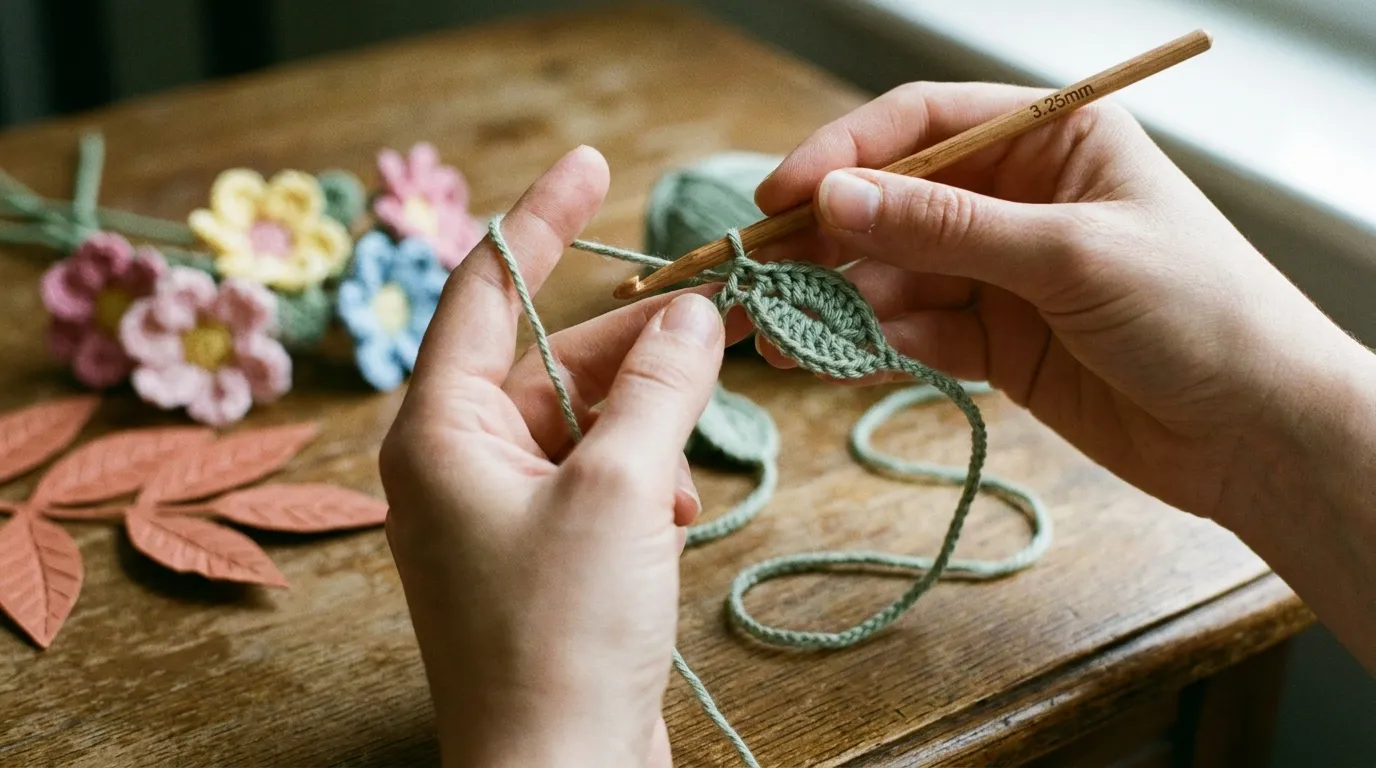
Motif 1: Sculpted Botanical Leaflet
(Make 34 standard leaflets in indicated color ratios)
- Foundation: Ch 12.
- Side 1: Sl st in 2nd ch from hook, sc in next ch, hdc in next ch, dc in next 4 ch, hdc in next ch, sc in next ch, [sc, ch 2, sl st in 2nd ch from hook, sc] in final end chain.
- Side 2 (Opposite Chain Edge): Working along bottom loops: sc in next ch, hdc in next ch, dc in next 4 ch, hdc in next ch, sc in next ch, sl st into base ch.
- Center Vein Accent: Sl st through the center ridge between sides back toward the leaf tip, then fasten off leaving a 10-inch tail for attachment.
Motif 2: Five-Petal Meadow Blossom
(Make 14 total: 6 Cream White, 5 Baby Pink, 3 Sky Blue)
Center Stamen (Sunny Yellow):
- Round 1: MR, ch 1, 10 sc in magic ring. Pull ring tight. Sl st to first sc to join. (10 sc). Fasten off Yellow.
Petal Round (Join Blossom Color in FLO):
- Round 2: Join petal yarn in any front loop. [Ch 2, 3 dc in same loop, ch 2, sl st in next loop] 5 times. (5 rounded petals).
- Fasten off, leaving a 12-inch tail on the wrong side.
Motif 3: Sinuous Main Stem Vine
- Using Sage Green:
- Foundation Chain: Ch 220 (approx. 48 inches unstretched).
- Row 1: Sl st into the back bump of the 2nd ch from hook and in each ch across. Fasten off.
- Lateral Branches (Make 8): Ch 40 to 60, sl st in back bumps across.
Assembly & Layout Mapping
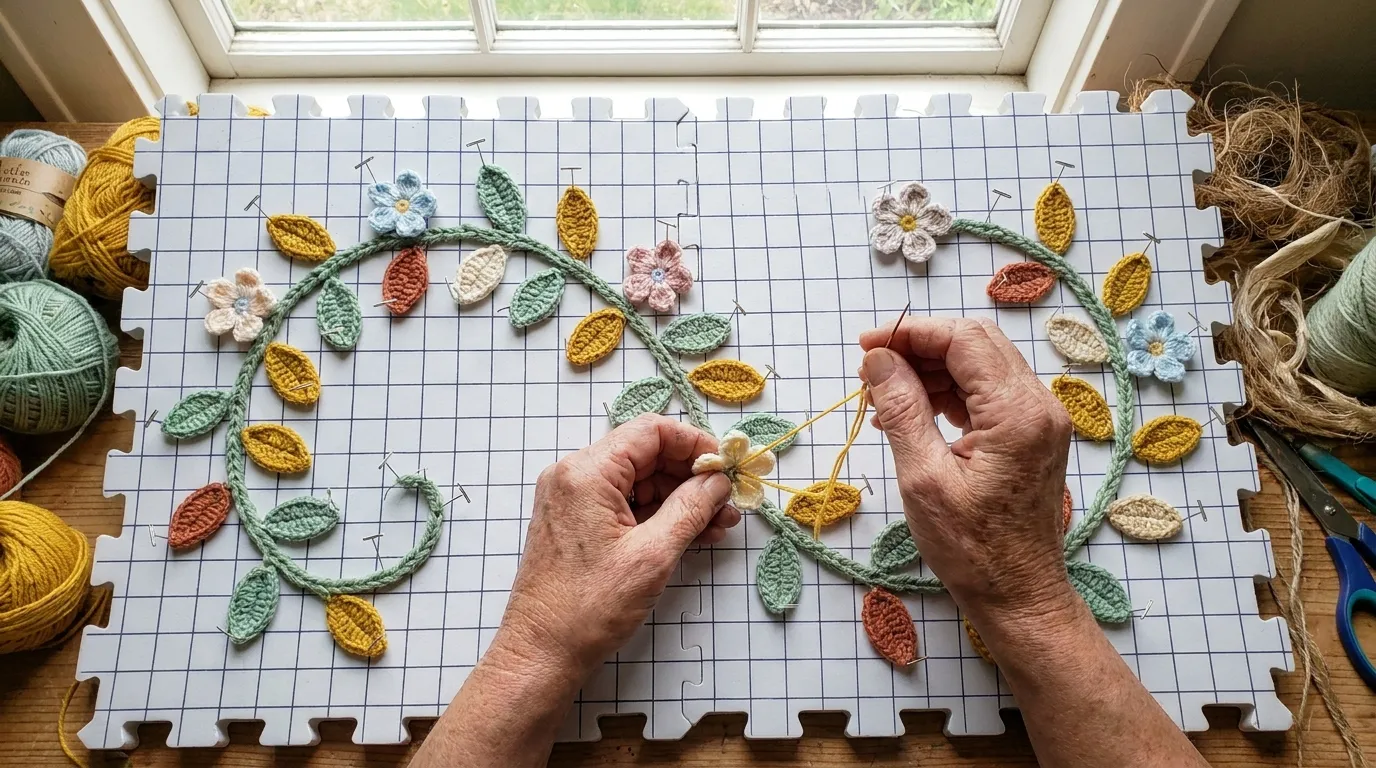
- Lay out your interlocking foam blocking board and trace a gentle, meandering S-curve across the center using T-pins.
- Pin the main Sage Green vine along the curve. Attach the 8 lateral branch tendrils at alternate intervals along the spine.
- Position the leaflets in pairs or clusters of three along the branches, alternating warm terracotta, ochre, sage, and mint.
- Nestle the five-petal blossoms at branch forks, pinning through the yellow flower centers.
- Using your tapestry needle and matching yarn tails, whipstitch each leaf base and flower firmly into the vine stems from the wrong side.
Wet Blocking & Maintenance
- Wet Pinning: Submerge the assembled runner in cool water with delicate fiber wash. Gently press between towels, then pin every leaf tip firmly into your blocking mat. Allow to dry for 24 hours.
- Washing: Hand-wash in cold water. Lay flat to dry to preserve delicate blossom petal contours.
Frequently Asked Questions
Can I make this with mercerized crochet thread (Size 10) instead of DK yarn?
Yes! Using Size 10 crochet thread with a 1.75mm hook will yield an ultra-fine, delicate lace runner suitable for vintage buffets or wedding table settings.
How do I prevent the long vine stems from twisting on the table?
Working slip stitches into the back ridge of your chains creates a flat, ribbon-like stem that naturally lays flush against tabletop wood. Thorough wet blocking is essential.
Did you create the Botanical Leaf & Blossom Table Runner? Share your finished table setting with our community on Instagram or Pinterest at @NailItHome.